(HealthDay News) -- Dysphagia, or difficulty swallowing, is a common problem among the elderly, according to The Center for Voice at Northwestern University.
Contributing factors could include poor teeth, ill-fitting dentures or a cold. One of the most common causes is gastroesophageal reflux, when stomach acid moves up the esophagus to the pharynx.
Medication and surgery can help treat dysphagia. Swallowing therapy performed by a speech pathologist also can help. If the problem persists, however, see an otolaryngologist -- more commonly known as an ear-nose-and-throat doctor.
Friday, August 25, 2006


Research Emphasizes Technology to Aid Elderly
(HealthDay News) -- "Intelligent" walkers and canes that issue an alert when they sense balance or motor problems are among the new kinds of technology for seniors being developed at the Oregon Roybal Center for Aging & Technology (ORCATECH) at Oregon Health & Science University, in Portland.
ORCATECH, a collaboration of academic, industry and community partners that is funded by the National Institutes of Health, is researching and creating technology to assess and improve how elderly people function in their homes. The objective is to help seniors maintain their independence, and offer them good health and quality of life.
The MedTracker pill dispenser is one example. It looks like an ordinary pill dispenser, but when each tiny compartment is opened, a wireless signal is sent to a computer system that records the medications taken from the dispenser. If it notices a senior has failed to take a medication, the system can send a reminder to the person.
"The data generated by MedTracker can also be used to recognize if the senior has begun to need more assistance with their medication, and may even be helpful in identifying early memory changes," MedTracker project lead investigator Tamara Hayes, an assistant professor of biomedical engineering, said in a prepared statement.
Other projects include a weight sensor-equipped bed that tracks sleep patterns, sensors used to track movement in homes, and adaptive computer games that monitor, and may help improve, seniors' cognitive performance, the researchers said.
More information
The U.S. Centers for Disease Control and Prevention offers advice on healthy aging.
ORCATECH, a collaboration of academic, industry and community partners that is funded by the National Institutes of Health, is researching and creating technology to assess and improve how elderly people function in their homes. The objective is to help seniors maintain their independence, and offer them good health and quality of life.
The MedTracker pill dispenser is one example. It looks like an ordinary pill dispenser, but when each tiny compartment is opened, a wireless signal is sent to a computer system that records the medications taken from the dispenser. If it notices a senior has failed to take a medication, the system can send a reminder to the person.
"The data generated by MedTracker can also be used to recognize if the senior has begun to need more assistance with their medication, and may even be helpful in identifying early memory changes," MedTracker project lead investigator Tamara Hayes, an assistant professor of biomedical engineering, said in a prepared statement.
Other projects include a weight sensor-equipped bed that tracks sleep patterns, sensors used to track movement in homes, and adaptive computer games that monitor, and may help improve, seniors' cognitive performance, the researchers said.
More information
The U.S. Centers for Disease Control and Prevention offers advice on healthy aging.
Healthy Aging: The 40s -- Middle-Aged, Mega-Stressed
(HealthDay News) -- Juggling the demands of children, full-time work and aging or sick parents, the 40s can be prime time for pressure.
While it's tempting to pretend it's not there, stress has a way of making itself known. "Some people can even feel physical pain -- problems with indigestion, heartburn or headaches," said Dr. Cecil Wilson, an internist in Winter Park, Fla., and board member of the American Medical Association.
There are more subtle signs, too. "You're more easily irritated; you feel like you're always behind," he said. "Some people may find that it's difficult to sleep -- or they sleep more than they normally would."
As stress mounts, the risk for depression rises. "Depression has many forms," Wilson said. "You might get up in the morning and just as soon not face the day. You feel overwhelmed with it all and are continually feeling low."
Recognizing that stress is getting out of hand is the first step to change, Wilson said. But even more important is identifying the sources of anxiety, and taking action.
"First, say to yourself 'Is it my environment?' You might look around and say, 'Things aren't going well at home with my kids,' or 'I've got an elderly parent I'm concerned about,'" Wilson advised.
The workplace can also be a huge source of pressure and anxiety, and often the easiest to change. "If you simply have too much work to handle, ask the boss for help," Wilson said. If that's no solution, switching jobs may be the only way to ease the stress load, he said.
The body has its own ready-made stress-buster, Wilson pointed out -- a good workout. "We all know that regular exercise is great for a variety of reasons, to ease tension and relax.
"Then there's even something as obvious as going on vacation, a weekend away from stressors," he added.
Many Americans swear by meditation, prayer, T'ai Chi -- even a midday nap.
Then there are diversions that seem like they relieve stress, but really compound it. "People under stress often drink more than they otherwise would," Wilson said. But that extra drink or two can lead to many more, until drinking becomes a habit that's hard to break. "It's the same thing for smoking -- people may smoke more, thinking it curbs stress, but it doesn't," he said.
Amid the hurly-burly of middle-age, it may also be important to step back and realize that a certain level of tension will always surround us.
"We hear a lot about high anxiety today, but I'm not sure we live in a more stressful world," Wilson said. "Life has always been stressful."
More information
For more on coping with the stress of everyday life, visit the National Mental Health Association.
While it's tempting to pretend it's not there, stress has a way of making itself known. "Some people can even feel physical pain -- problems with indigestion, heartburn or headaches," said Dr. Cecil Wilson, an internist in Winter Park, Fla., and board member of the American Medical Association.
There are more subtle signs, too. "You're more easily irritated; you feel like you're always behind," he said. "Some people may find that it's difficult to sleep -- or they sleep more than they normally would."
As stress mounts, the risk for depression rises. "Depression has many forms," Wilson said. "You might get up in the morning and just as soon not face the day. You feel overwhelmed with it all and are continually feeling low."
Recognizing that stress is getting out of hand is the first step to change, Wilson said. But even more important is identifying the sources of anxiety, and taking action.
"First, say to yourself 'Is it my environment?' You might look around and say, 'Things aren't going well at home with my kids,' or 'I've got an elderly parent I'm concerned about,'" Wilson advised.
The workplace can also be a huge source of pressure and anxiety, and often the easiest to change. "If you simply have too much work to handle, ask the boss for help," Wilson said. If that's no solution, switching jobs may be the only way to ease the stress load, he said.
The body has its own ready-made stress-buster, Wilson pointed out -- a good workout. "We all know that regular exercise is great for a variety of reasons, to ease tension and relax.
"Then there's even something as obvious as going on vacation, a weekend away from stressors," he added.
Many Americans swear by meditation, prayer, T'ai Chi -- even a midday nap.
Then there are diversions that seem like they relieve stress, but really compound it. "People under stress often drink more than they otherwise would," Wilson said. But that extra drink or two can lead to many more, until drinking becomes a habit that's hard to break. "It's the same thing for smoking -- people may smoke more, thinking it curbs stress, but it doesn't," he said.
Amid the hurly-burly of middle-age, it may also be important to step back and realize that a certain level of tension will always surround us.
"We hear a lot about high anxiety today, but I'm not sure we live in a more stressful world," Wilson said. "Life has always been stressful."
More information
For more on coping with the stress of everyday life, visit the National Mental Health Association.
(HealthDay News) -- Hot weather can play havoc with blood pressure, sending it up in seniors and down in the middle-aged, a new Italian study shows.
(HealthDay News) -- Hot weather can play havoc with blood pressure, sending it up in seniors and down in the middle-aged, a new Italian study shows.
For those over 65 who have hypertension, hot nights translate into higher blood pressure readings, but for younger patients, "physicians should reconsider reducing blood pressure medication in the summer," said lead researcher Dr. Pietro Amedeo Modesti, an associate professor of internal medicine at the University of Florence. That's because pressure for patients under 65 tends to fall in the summer.
The findings suggest a need to adjust patients' medications when the weather changes, the researchers conclude in the current issue of Hypertension.
Modesti's team tracked the 24-hour blood pressure of more than 6,400 people, average age 59, in Milan and Florence over a 14-month period. They then correlated those measurements with round-the-clock weather reports.
When the weather was hot, with daytime temperatures from 78 to over 90 degrees, daytime systolic blood pressure -- the higher number in a 120/80 reading -- was significantly lower than on cooler days, the researchers found.
Hot nights were associated with significantly higher blood pressure in people over 65, but not in younger people.
"We did not have information on the air temperature inside people's homes, but in Italy air conditioning is not widely used," Modesti added.
The study also found that the number of different drugs for blood pressure control taken by the older people was significantly lower on hot days (average 1.71) than on cold days (2.3). The researchers found no such relationship for people under 50.
The information should be taken into account when planning trials of blood pressure treatment, Modesti said.
"If you enroll patients into a drug trial without considering the season, you could introduce bias," he noted.
The study is interesting but hardly conclusive, said an American expert, Dr. Daniel Jones, dean of the University of Mississippi School of Medicine and a spokesman for the American Heart Association.
The study was "observational," meaning that it did not control for outside factors that might affect the results. "So the link is very early in terms of an association," Jones said.
If the finding holds up, it might eventually have an effect on medical practice, Jones said. "There might be some products designed to be given at night or be released at night," he said.
But at the moment, the study, while it explores "an intriguing research issue that deserves follow-up, would not change medical practice at the present time," Jones said.
More information
Find out more about high blood pressure at the American Heart Association.
For those over 65 who have hypertension, hot nights translate into higher blood pressure readings, but for younger patients, "physicians should reconsider reducing blood pressure medication in the summer," said lead researcher Dr. Pietro Amedeo Modesti, an associate professor of internal medicine at the University of Florence. That's because pressure for patients under 65 tends to fall in the summer.
The findings suggest a need to adjust patients' medications when the weather changes, the researchers conclude in the current issue of Hypertension.
Modesti's team tracked the 24-hour blood pressure of more than 6,400 people, average age 59, in Milan and Florence over a 14-month period. They then correlated those measurements with round-the-clock weather reports.
When the weather was hot, with daytime temperatures from 78 to over 90 degrees, daytime systolic blood pressure -- the higher number in a 120/80 reading -- was significantly lower than on cooler days, the researchers found.
Hot nights were associated with significantly higher blood pressure in people over 65, but not in younger people.
"We did not have information on the air temperature inside people's homes, but in Italy air conditioning is not widely used," Modesti added.
The study also found that the number of different drugs for blood pressure control taken by the older people was significantly lower on hot days (average 1.71) than on cold days (2.3). The researchers found no such relationship for people under 50.
The information should be taken into account when planning trials of blood pressure treatment, Modesti said.
"If you enroll patients into a drug trial without considering the season, you could introduce bias," he noted.
The study is interesting but hardly conclusive, said an American expert, Dr. Daniel Jones, dean of the University of Mississippi School of Medicine and a spokesman for the American Heart Association.
The study was "observational," meaning that it did not control for outside factors that might affect the results. "So the link is very early in terms of an association," Jones said.
If the finding holds up, it might eventually have an effect on medical practice, Jones said. "There might be some products designed to be given at night or be released at night," he said.
But at the moment, the study, while it explores "an intriguing research issue that deserves follow-up, would not change medical practice at the present time," Jones said.
More information
Find out more about high blood pressure at the American Heart Association.
Saturday, August 19, 2006
Alternative medicine offers options for fertility treatments
After three years of trying to conceive and three failed attempts at in vitro fertilization, Tracey Carroll, 33, desperately turned to the East for help. She sought the needles and herbs of an acupuncturist.
In fact, her new in-vitro doctor insisted. After she had her fourth session of getting pricked, her menstrual cycle became regular for the first time in three years. Carroll also swallowed 18 pills of "smelly, yucky herbs" of which the ingredients were derived from cow spleen and pituitary gland believed to regulate her hormones.
Six months later, the woman is now expecting twins, due in December - and believes acupuncture played a large role.
Carroll is among an increasing number of American women who are turning to alternative, Eastern medicinal arts for problems with infertility, menopause, weight loss and even dry skin.
Once dismissed as mystical quackery by many medical doctors, acupuncture treatments are now recommended by some in-vitro specialists as a way to increase fertility.
Meanwhile, other women turn to ayurveda - a 5,000-year-old practice from India that incorporates mind, body and spirit - to ensure health. Women turn to it to rid their body of toxins and dull skin. Both Eastern holistic approaches employ herbs and massage or acupuncture to bring the body into balance.
Carroll, a teacher, says that in her first session, Milpitas, Calif., acupuncturist Robin Hays diagnosed that her natural killer cells in her immune system were elevated, which meant her body might attack an embryo. A week later, blood tests confirmed it.
Acupuncture, an integral part of traditional Chinese medicine, stimulates blood flow and encourages better circulation. Needles are inserted into the body at various energy points, which correspond to organs in the body. Acupuncturists also employ herbs to bring balance to the body.
For women trying to conceive, acupuncture often focuses on the uterus, Hays says.
"It's creating a fertile valley to grow a seed or an embryo," she says. Hays, who turned to acupuncture for a sprained ankle two decades ago, was so delighted with the results that she pursued it as a profession. She graduated from San Francisco's American College of Traditional Chinese Medicine in 1985.
Back then, it was mostly Chinese and older hippies who turned to acupuncture, Hays says. Her patients didn't even tell their primary doctors about their treatments because most of the medical establishment eyed it suspiciously. Now, some insurance plans cover acupuncture, and she's getting referrals from doctors, including Dr. Christo Zouves of the Zouves Fertility Center in Daly City, Calif.
Eighty-five percent of patients at the fertility center undergo acupuncture as part of their treatments, Zouves says. He also recommends yoga, meditation and eating healthily to his patients.
"It's about the mind/body connection," says Zouves, who adopted Eastern holistic approaches to his practice a decade ago.
His experience and medical studies show that acupuncture stimulates blood flow to the pelvis and uterus. "We don't know how it works, but it does," he says.
At Hays' practice, about half of the patients see her for women's health issues, including premenstrual syndrome, irregular menstrual cycles and menopause. She also treats many patients for pain disorders and allergies.
"Most of my patients come because they don't want to take drugs," she says.
Meanwhile, other women are turning to ayurvedic remedies, which use herbal treatments, tailored diets and massage to build up immune systems and detoxify bodies. Across the country, ayurvedic spas have sprung up to pamper women and promise radiant skin. A survey of spas offering "wellness treatments" in 2004 found that 12 percent added ayurvedic services while an additional 7 percent planned to, according to the International Spa Association.
Ayoma LifeSpa in San Jose, Calif., offers ayurvedic massage treatments as well as longer-term nutritional consultations for regular members. Before each treatment, clients fill out a questionnaire so an ayurvedic consultant can gauge the imbalances in their body.
By McClatchy/Tribune Information Services
In fact, her new in-vitro doctor insisted. After she had her fourth session of getting pricked, her menstrual cycle became regular for the first time in three years. Carroll also swallowed 18 pills of "smelly, yucky herbs" of which the ingredients were derived from cow spleen and pituitary gland believed to regulate her hormones.
Six months later, the woman is now expecting twins, due in December - and believes acupuncture played a large role.
Carroll is among an increasing number of American women who are turning to alternative, Eastern medicinal arts for problems with infertility, menopause, weight loss and even dry skin.
Once dismissed as mystical quackery by many medical doctors, acupuncture treatments are now recommended by some in-vitro specialists as a way to increase fertility.
Meanwhile, other women turn to ayurveda - a 5,000-year-old practice from India that incorporates mind, body and spirit - to ensure health. Women turn to it to rid their body of toxins and dull skin. Both Eastern holistic approaches employ herbs and massage or acupuncture to bring the body into balance.
Carroll, a teacher, says that in her first session, Milpitas, Calif., acupuncturist Robin Hays diagnosed that her natural killer cells in her immune system were elevated, which meant her body might attack an embryo. A week later, blood tests confirmed it.
Acupuncture, an integral part of traditional Chinese medicine, stimulates blood flow and encourages better circulation. Needles are inserted into the body at various energy points, which correspond to organs in the body. Acupuncturists also employ herbs to bring balance to the body.
For women trying to conceive, acupuncture often focuses on the uterus, Hays says.
"It's creating a fertile valley to grow a seed or an embryo," she says. Hays, who turned to acupuncture for a sprained ankle two decades ago, was so delighted with the results that she pursued it as a profession. She graduated from San Francisco's American College of Traditional Chinese Medicine in 1985.
Back then, it was mostly Chinese and older hippies who turned to acupuncture, Hays says. Her patients didn't even tell their primary doctors about their treatments because most of the medical establishment eyed it suspiciously. Now, some insurance plans cover acupuncture, and she's getting referrals from doctors, including Dr. Christo Zouves of the Zouves Fertility Center in Daly City, Calif.
Eighty-five percent of patients at the fertility center undergo acupuncture as part of their treatments, Zouves says. He also recommends yoga, meditation and eating healthily to his patients.
"It's about the mind/body connection," says Zouves, who adopted Eastern holistic approaches to his practice a decade ago.
His experience and medical studies show that acupuncture stimulates blood flow to the pelvis and uterus. "We don't know how it works, but it does," he says.
At Hays' practice, about half of the patients see her for women's health issues, including premenstrual syndrome, irregular menstrual cycles and menopause. She also treats many patients for pain disorders and allergies.
"Most of my patients come because they don't want to take drugs," she says.
Meanwhile, other women are turning to ayurvedic remedies, which use herbal treatments, tailored diets and massage to build up immune systems and detoxify bodies. Across the country, ayurvedic spas have sprung up to pamper women and promise radiant skin. A survey of spas offering "wellness treatments" in 2004 found that 12 percent added ayurvedic services while an additional 7 percent planned to, according to the International Spa Association.
Ayoma LifeSpa in San Jose, Calif., offers ayurvedic massage treatments as well as longer-term nutritional consultations for regular members. Before each treatment, clients fill out a questionnaire so an ayurvedic consultant can gauge the imbalances in their body.
By McClatchy/Tribune Information Services
Centre willing to help Tamil Nadu to promote Indigenous medicine
Chennai, Jul 16: Centre was willing to help Tamil Nadu in promoting Indian Systems of Medicine and the government was now preparing a project report to be submitted to it in this regard, sate Health Minister K K S S R Ramachandran, said today.The state government was keen to set up an Ayurveda college and would take all efforts in this direction, he said while inaugurating a meeting of the state chapter of the All India Ayurvedic Congress (AIAC) as part of its centenary.The government would take suitable measures for popularising Siddha and Ayurveda as they did not have any side effect and were cost effective.The DMK government was keen on providing medical education even to the poor students and towards this direction was taking efforts to set up government medical colleges in each and every district of the state at a cost of Rs 100 crore.AIAC state president S Dhanvanthri Premvel also spoke on the occasion.
Abdul Nasser Madhani leader thanks Tamil Nadu, Kerala CMs
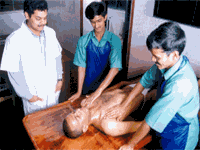 Coimbatore, Jul 12: Kerala-based People's Democratic Party (PDP) leader and a key accused in the 1998 serial bomb blasts, Abdul Nasser Madhani today thanked Tamil Nadu chief Minister M Karunanidhi for directing officials to arrange for ayurveda treatment for his various ailments in the Central prison here itself.In a release circulated through his lawyers, Madhani, lodged in the prison for the last eight years, thanked the state government and Karunanidhi, in helping to get treatment on 'humanitarian grounds.' He also thanked Kerala Chief Minister V S Achuthanandan for taking up the issue with Karunanidhi personally and also the doctors of Arya Vaidya Pharmacy for providing the treatment.
Ayurveda for good health and illness prevention
.GIF) By Guardian Health
By Guardian HealthAyurveda, or ayurvedic medicine, is a health system that people in India have used for more than 5,000 years. Ayurveda emphasizes good health and prevention of illness through lifestyle practices (such as massage, meditation, yoga, and dietary changes) and the use of herbal remedies. Ayurvedic medicine is holistic, which means viewing the body and mind as a whole.
Ayurveda not only treats a person’s physical complaints, but it also changes lifestyle practices to help maintain or improve health. According to ayurveda, the five elements of nature (space, air, fire, water, earth) show themselves in the body as three forces (doshas) known as Vatta, Pitta, and Kapha.
These doshas relate closely to the basic elements of nature and to specific functions of the body. A balance of these doshas is thought to be required for optimal health. Air and space represent Vatta. Vatta controls muscle and joint movement, breathing, and heartbeat.
Also, Vatta controls anxiety, fear, pain, and other functions of the nervous system. Fire and water represent Pitta, which is thought to control such bodily functions as digestion, metabolism, intelligence, and skin color. Pitta governs the emotions of anger, hate, and jealousy. Earth and water represent Kapha.
The physical structure of the body and the immune system are governed by Kapha. Emotional responses thought to be controlled by Kapha include calmness, forgiveness, love, and greed. The doshas, which are determined at the time of conception, also relate to an individual’s physical makeup and personality.
A person with a Vatta makeup tends to have a small, thin build. The Pitta body style is more of a medium, muscular build. The Kapha appearance is usually bigger and well-developed. Most people are considered to have a combination of doshas, with one type usually being predominant.
In ayurvedic medicine, it is thought that if an imbalance occurs in any of the three doshas, illness results. Ayurvedic medicine treats illness through a variety of means, including dietary changes, herbal remedies, and exercise. You can also use yoga, meditation, or counseling to treat disease under this philosophy.
People use ayurvedic practices to maintain health, reduce stress, and improve flexibility, strength, and stamina. Researchers currently are studying yoga and meditation as interventions for diseases such as asthma, high blood pressure, and arthritis. Ayurveda stresses proper diet for maintaining good health and treating disease.
Herbal medicines are prescribed based on the person’s dosha type. Researchers are looking into the effects of ayurvedic herbal medicines on various long-term (chronic) illnesses. Ayurvedic practices such as yoga and meditation can be safe ways to promote health. If you have a long-term illness, you may be able to combine ayurveda with conventional medical treatment.
Always tell your doctor if you are using an alternative therapy or if you are thinking about combining an alternative therapy with your conventional medical treatment. It may not be safe to forgo your conventional medical treatment and rely only on an alternative therapy.
Ayurvedic herbal medications, like conventional medications, may cause side effects, trigger allergic reactions, or interact with other medications or herbs you are taking. Some ayurvedic medications may contain high levels of heavy metals.
A recent study found that about one in five ayurvedic medicine products available in grocery stores in the Boston area contained potentially harmful levels of lead and other heavy metals. Be sure to tell your doctor about all herbs and natural supplements that you are taking. If you have taken ayurvedic medicine products, ask your doctor about screening for heavy metals.
SOURCE: Guardian
SOURCE: Guardian
Subscribe to:
Posts (Atom)
Weight Loss Ebook - Secrets Revealed - Revised Edition$19.95  This is not only a weight loss program, it is also a plan for "TOTAL HEALTH". If you want a quick fix (taking metabolism boosters, etc.), only to gain more weight when you stop, do not even consider this program. Our program is designed to change the way you think and live your life. Change is only a decision away. You can do this! If you are motivated, and truly care about taking care of your body, and you are willing to make changes in your life, then this program is for you! - E-Book Version.(WL) |